
-
About Us
-
-
-
-
-
Contact Us
Service Support
General knowledge of heads
Heads are indispensable and critical components in pressure vessel equipment across various industries, ranging from petrochemicals and atomic energy to food and pharmaceuticals.
Purpose of heads
01. Heads are indispensable and critical components in pressure vessel equipment across various industries, ranging from petrochemicals and atomic energy to food and pharmaceuticals.
02. The heads, serving as the end cap of a pressure vessel, are the primary pressure-bearing component of the vessel.
03. The quality of the head has a direct impact on the pressure vessel’s long-term safety and reliability.
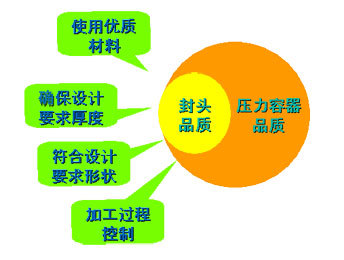
The importance of head quality
The importance of head shapes
| Section shape of head | Curvature of the central part of the head | Necessary head plate thickness in design | Design plate thickness of the head when the plate thickness of the cylinder is 20mm |
| Hemispherical (HH) | R = d× 0.5 | 1/2 of the thickness of the cylinder plate | 10mm |
| 2:1 elliptic (EH) | R = D× 0.9 (approximation) | Same thickness as cylinder plate | 20mm |
| 10% dish head (DHB) | R=D | Thickness of cylinder plate × 1.54 | 31mm |
| Flat cover (flat plate) | R = infinite | 8 times the thickness of the cylinder plate | 160mm |
Requirements for head shape

JB/T4746 head standard:
The shape of the head must be checked with a full template.
Shape tolerance: convex not more than 1.25%Di, concave not more than 0.625%Di.
The inner radius of the transition section shall not be less than the value specified in the drawing.
Spherical body: curvature affects head thickness
Transition section: reduce the peak stress of the connection between the spherical surface and the cylinder
Straight edge: avoid the superposition of the peak stress of the transition section and the welding stress of the cylinder group pair
Head processing methods
| Method of construction | Hot stamping | cold stamping | cold spinning | slice method |
| Main process | Preheating stamping | Stamping | drum spinning | Suppression group pair |
| Molding equipment | heat treatment furnace Press (die set) |
Press (die set) | drum press Spinning machine |
Press (pad die) heat treatment furnace |
| workpiece temperature | Preheating | Normal temperature | Normal temperature | Normal temperature/preheating |
| Suitable material | high strength steel ultra-high strength steel |
Stainless steel carbon steel |
Stainless steel carbon steel |
Unlimited |
| Suitable specifications | Standard | Standard | sheet thin Larger diameter |
Plate thickness Large diameter |
| Characteristics of construction method | ① Slightly rough surface ② Difficult to control size ③ Impact on the environment |
① Excellent surface quality ② Same size ③ Batch manufacturing is good |
① Surface indentation ② Size can be controlled ③ Die cost saving |
① On-site pairing ② Long processing cycle |
Cold working vs. Hot working
| Characteristics of cold working | Characteristics of hot working |
| 1. Without heating, there will be no material deterioration, especially suitable for stainless steel head processing. | Due to heating, material deterioration will occur, resulting in corrosion resistance of stainless steel head decreased, not suitable for stainless steel head processing. |
| 2. Without heating, there will be no dimensional change caused by cooling shrinkage, the shape is regular, the size is accurate and the consistency is good | Heat forming, resulting in thermal expansion of the mold and head cooling shrinkage, the size is difficult to control and poor consistency. |
| 3. Without heating, the surface of the head after forming maintains the smooth surface of the original material, and the appearance is beautiful. | Due to heating, the surface oxide scale of the head after forming is serious and difficult to remove. |
| 4. No need for fuel, less energy consumption. | It requires fuel and consumes valuable resources. |
| 5. No heating, no harmful gas and smoke, to avoid environmental pollution and global warming, consistent with China's national policy. | Due to the heating of a large number of harmful gases, pollution of the environment, resulting in public hazards, contrary to China's national policy. |
Jiuzhou Head
Tel: +86-0510-87849500
Fax: 0510-87849507
Address: 198 Wanyuan Road, Wanshi Town, Yixing City, Jiangsu Province
Zip Code: 214212
E-mail: jzftdz@jzftdz.cn

Follow Us
Copyright © 2024 Yixing Jiuzhou Head Forging Co., Ltd. Business License


